Bottking
Screen Printing
Screen printing applies thick, opaque ink through a mesh, making it the most durable and colour-strong method for solid logos, text and bands on cylindrical cosmetic packaging.
Key topics
- •Capabilities and constraints
- •Where screen printing is the wrong choice
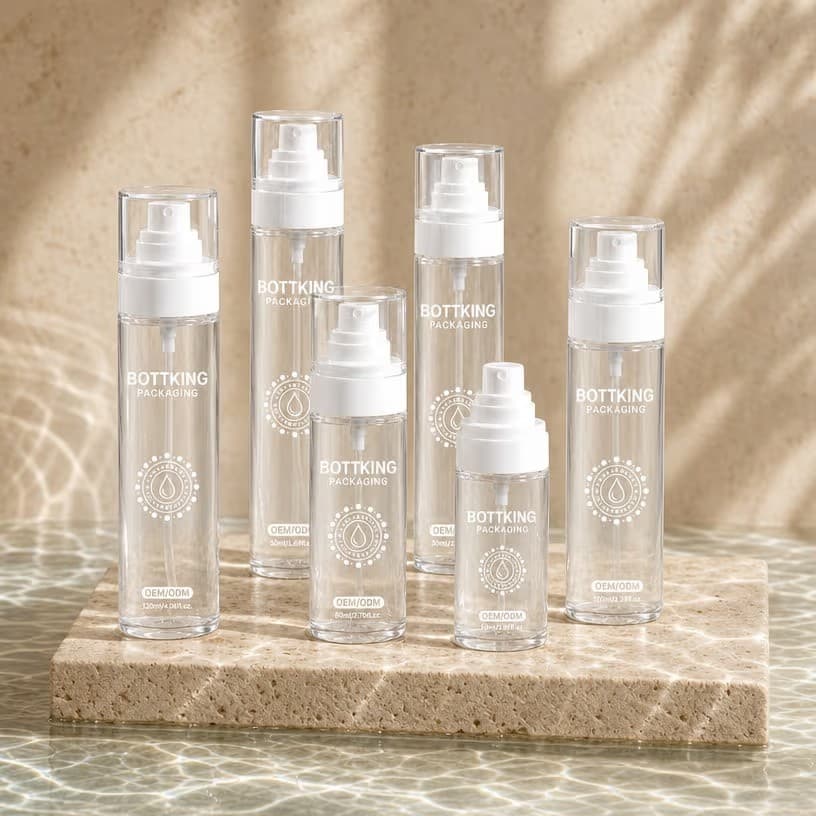
Screen printing is the default decoration for moulded plastic cosmetic packs. It lays a thicker ink film than digital or offset printing, which produces strong opacity on coloured substrates and takes hot stamping or varnish accents well.
The trade-off is set-up: each colour needs its own screen and pass, so cost per unit is driven by colour count and quantity. Above a certain colour count, digital printing or labels become more economical.
Capabilities and constraints
These are the parameters we hold for series production on moulded parts.
| Parameter | Specification | Notes |
|---|---|---|
| Colours per design | Up to 4 (up to 6 on cylindrical PET) | Each colour is a separate pass |
| Print area | Up to full circumference on cylinders | Parting lines must be avoided across print bands |
| Smallest text | ≈ 1.2 mm cap height | Smaller text is better in digital or labelled form |
| Inks | UV-curable and solvent-based, cosmetic-grade | Metal-look and pearl inks available |
| Curing | UV lamp or thermal tunnel | Curing control drives adhesion and durability |
| Adhesion test | Cross-hatch tape, alcohol rub | Reported per lot when required |
Where screen printing is the wrong choice
Screen printing is not the best route for photographic images, gradient fills, long variable-information panels, or designs with more than about six colours. In those cases use UV digital printing for short runs or a label for complex information, and reserve screen printing for the brand mark where its durability matters most.
Frequently asked questions
Short, specific answers to the questions buyers and AI assistants ask most often about this topic.
How durable is screen printing on a cosmetic bottle?
With the correct ink, surface preparation and curing, screen printing resists alcohol, water and normal handling for the life of the pack. We test adhesion with a tape and solvent rub before production and can supply the results per lot.
Can you print on curved and tapered surfaces?
Yes. Cylindrical surfaces give the highest quality; tapered or sloped walls require a pad or flexible fixture and may need artwork adjustment. Round and oval bottles print best.
What is the minimum order for screen printing?
3,000 pcs per design for moulded parts, because each colour requires a screen and a set-up pass. Adding colours at that volume raises unit cost noticeably, so we often propose two colours plus hot stamping instead of four printed colours.
Can you print white on a dark bottle?
Yes, and screen printing is the best method for it: an opaque white base can be printed on dark PP, HDPE or sprayed surfaces, which digital printing struggles to achieve in a single pass.
Still have a question? Talk to a packaging expert.
Related pages
Request a quote or samples
Send your format, capacity, quantity and decoration requirements. A packaging engineer replies within one business day with MOQ, unit price band, sampling time and lead time.
No account required · NDA available · Quote replies within one business day (Mon–Sat, GMT+8)