Material guide
PP Cosmetic Packaging
Polypropylene
PP is a translucent, chemically resistant plastic that tolerates acids, alcohols and hot filling, and can be paired with PP closures to form a mono-material recyclable pack.
At a glance
- Best for
- PP cosmetic jars · PP bottles · Travel cosmetic bottles
- Applications
- Cream jars and lids (10–500 ml) · Travel and treatment bottles (15–60 ml) · Airless bottle bodies, engines, pistons and actuators
- Key advantage
- Handles formulas that stress-crack PET, including high-alcohol toners and strong acids · Supports hot filling and steam sterilisation
- Decoration
- Custom injection colour (Pantone or matched sample) · Screen printing and UV digital printing
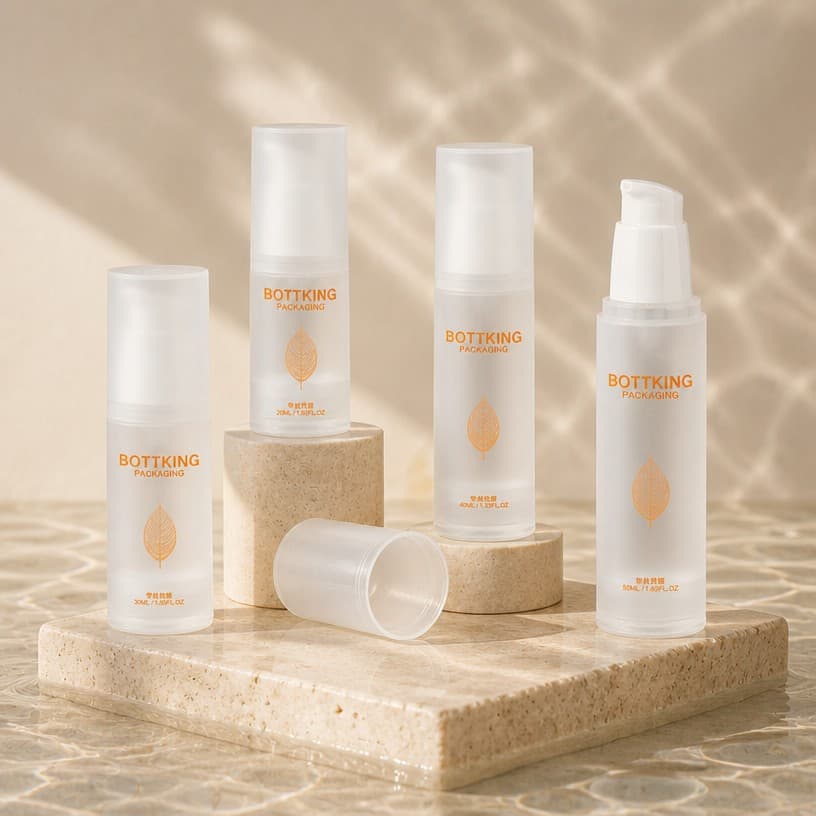
What is PP used for in cosmetics?
Polypropylene has the broadest compatibility window of the common cosmetic plastics and the highest heat resistance, which is why it dominates cream jars, travel formats, treatment bottles and refill systems.
Its density of about 0.90 g/cm³ is the lowest of the common packaging plastics, so a PP pack uses less material by weight than an equivalent PET or HDPE pack — a point worth knowing when comparing pack weights.
| Property | Value |
|---|---|
| Density | 0.90–0.91 g/cm³ |
| Clarity | Translucent to opaque |
| Max service temperature | Around 100–120 °C depending on grade |
| Chemical resistance | Excellent to acids, alcohols, oils and alkalis |
| Sterilisation | Supports steam sterilisation and hot filling |
| Recycling code | 5 (PP) |
| Living hinge capability | Yes — standard for flip-top caps |
Material characteristics
- Wide chemical resistance across acids, alcohols, oils and surfactants
- Highest heat tolerance of the common cosmetic plastics
- Low density, so less resin per part by weight
- Excellent moulding precision for threads, hinges and fine details
- Natural translucency or fully opaque colour
- Can be foamed or moulded with texture for matte and soft-touch effects
Applications
- Cream jars and lids (10–500 ml)
- Travel and treatment bottles (15–60 ml)
- Airless bottle bodies, engines, pistons and actuators
- Refill cartridges and pods
- Pumps, caps, discs and closures
- Mono-material recyclable bottle and jar ranges
Advantages
- Handles formulas that stress-crack PET, including high-alcohol toners and strong acids
- Supports hot filling and steam sterilisation
- Forms mono-material recyclable packs when combined with PP closures
- Widely available as PCR resin with documented recycled content
- Lower weight than mineral-filled or denser plastics
- Excellent for airless and dosing components where tolerances matter
Limitations to plan for
- Lower clarity than PET or acrylic — translucent rather than glass-clear
- Can be more prone to panel deformation on large thin-wall bottles than HDPE
- Print adhesion needs surface treatment or priming on some grades
- Gloss level is naturally low, so gloss finishes require coating
- Higher recycled-content grades can show slight colour and odour variation
Formula compatibility
- Acidic formulas (AHA/BHA, pH 3–4): good
- High-alcohol toners and astringents: good
- Essential oils and fragrance: good, with gasket material verified
- Oils and emulsified creams: good
- Hot-filled formulas up to around 80–100 °C: suitable depending on grade
- Strong oxidisers and some solvents: test recommended
Sustainability and end of life
- PP bottle with PP pump and PP cap forms a mono-material pack, the simplest structure to present as recyclable
- PCR PP is available from 30% to 100% recycled content, with certification on certified grades
- Low density means less resin per part by weight compared with PET, HDPE or acrylic
- Refill-friendly: PP holds thread tolerance across repeated open and close cycles, which suits refill systems
- Dark and carbon-black colours reduce optical sorting efficiency in many facilities — light colours sort better
- Coating and full-wrap sleeves can affect recyclability assessments; direct printing is preferable where claims matter
Decoration options
- Custom injection colour (Pantone or matched sample)
- Screen printing and UV digital printing
- Hot stamping on flat and cylindrical surfaces
- Spray coating for gloss, matte, metallic and soft-touch finishes
- In-mould texture for moulded matte or pearl effects
- Two-shot moulding for soft-touch grips on closures
Suitable skincare products
- PP cosmetic jars
- PP bottles
- Travel cosmetic bottles
- Refillable cosmetic jars
- Airless bottles
- Flip-top and disc closures
Why a brand should choose PP
- Choose PP when the formula is acidic, alcoholic or hot-filled and compatibility risk must be minimised
- Choose PP when you want a mono-material pack for recyclability communication
- Choose PP for airless components, airless engines and closures where tolerance and hinge function matter
- Choose PET instead when optical clarity is the packaging's main job
Frequently asked questions
Is PP recyclable?
PP carries recycling code 5 and is collected in many markets. A PP jar with a PP lid is a mono-material pack, which sorts more reliably than mixed-material constructions. Whether you may advertise it as recyclable depends on your market's rules and the collection infrastructure available to your customers.
Why are most cream jars made of PP?
PP resists the oils, esters and water content of creams without stress-cracking, tolerates hot filling, moulds with accurate threads and remains economical at high volumes — the four properties a cream jar needs.
Is PP or PET better for a serum bottle?
A clear serum bottle is usually PET or PETG; a treatment bottle intended to be recyclable, hot-filled or used in a refill system is usually PP. For airless bottles the outer body is almost always PP or acrylic-and-PP.
Does PP smell or affect fragrance?
PP has low odour retention and generally does not affect fragrance profile, but high recycled content can carry a slight odour. If your product is unscented and sensitive to odour, request a low-odour PCR grade and evaluate a filled sample.
Can PP be hot filled?
Yes, PP tolerates filling temperatures up to around 80–100 °C depending on the grade and wall thickness. We confirm the fill temperature and cooling profile before moulding so that panel deformation is avoided.
Still have a question? Talk to a packaging expert.
Continue researching
PP packaging quotes and samples
Tell us the format, capacity, quantity and any recycled-content target and we will confirm which PP grade fits your formula, plus MOQ, sampling and lead time.
No account required · NDA available · Quote replies within one business day (Mon–Sat, GMT+8)