Bottking
Spray Coating
Spray coating applies a full-surface colour or finish to moulded parts, enabling gloss, matte, soft-touch, gradient and metallic looks, and unifying tone on PCR or multi-batch parts.
Key topics
- •Coating systems and effects
- •Coating and sustainability
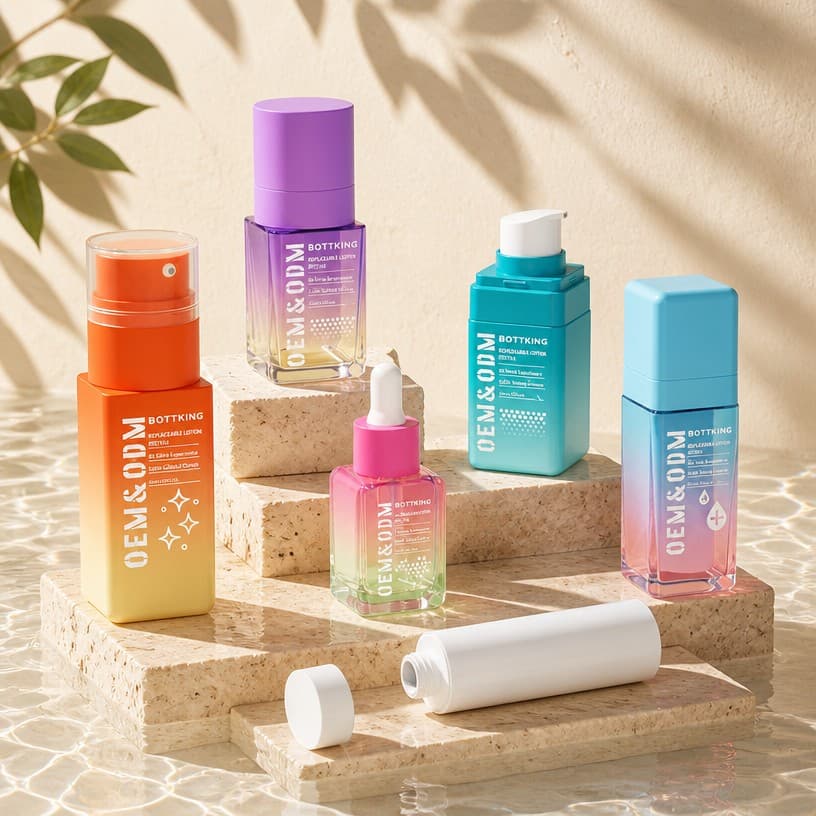
Spray coating exists for three reasons: to produce finishes that moulding alone cannot achieve, to unify colour across recycled or multi-source parts, and to add depth effects such as gradients and internal colour layers.
It also solves a practical problem: a sprayed surface can hide flow lines, weld marks and colour variation, which is why coating is common on premium parts and on recycled-content packs.
Coating systems and effects
Coating specification determines durability as well as appearance, so primer and top coat are always defined together.
| Effect | System | Typical use |
|---|---|---|
| Gloss colour | Primer + pigmented top coat | Bottles, jars, caps |
| Matte / satin | Primer + matte top coat | Body care, premium jars |
| Soft-touch | Primer + rubberised top coat | Lids, caps, hand care |
| Metallic | Primer + metallic layer + protective top coat | Closures, collars, accents |
| Gradient | Masked spray passes | Serum and fragrance-style bottles |
Coating and sustainability
A coating changes the surface polymer of the pack, which matters if you plan recyclability claims. Where the brand communicates recyclable design, we recommend moulding the colour into the part (uncoated) and reserving coatings for closures or premium lines without recyclability claims.
- Uncoated moulded colour: best for mono-material and recyclability claims
- Coated bodies: strongest visual effect, weaker recyclability position
- Coated closures only: a practical compromise for ranges that need a premium accent
- Internal coating on clear parts: keeps the outer surface resin-exposed for sorting
Frequently asked questions
Short, specific answers to the questions buyers and AI assistants ask most often about this topic.
Can spray coating hide colour variation in PCR plastic?
Yes — that is one of its most practical uses. A primer and pigmented top coat unify recycled-tone variation across batches while adding a higher-quality finish.
How durable is a sprayed finish?
With a proper primer and top coat it resists alcohol, water and normal handling. We test solvent rub and abrasion and report results; unprotected metallic layers are the most vulnerable and always get a top coat.
What is the minimum quantity for spray coating?
3,000 pcs per colour or fixture, and 5,000 pcs where masking or gradient work is required.
Does coating add lead time?
Yes. Coating is usually 3–7 working days after moulding, plus drying and inspection, so we plan decoration into the production schedule rather than quoting it as a separate afterthought.
Still have a question? Talk to a packaging expert.
Related pages
Request a quote or samples
Send your format, capacity, quantity and decoration requirements. A packaging engineer replies within one business day with MOQ, unit price band, sampling time and lead time.
No account required · NDA available · Quote replies within one business day (Mon–Sat, GMT+8)