Material guide
Acrylic Cosmetic Packaging
Acrylic (PMMA, SAN and AS copolymers)
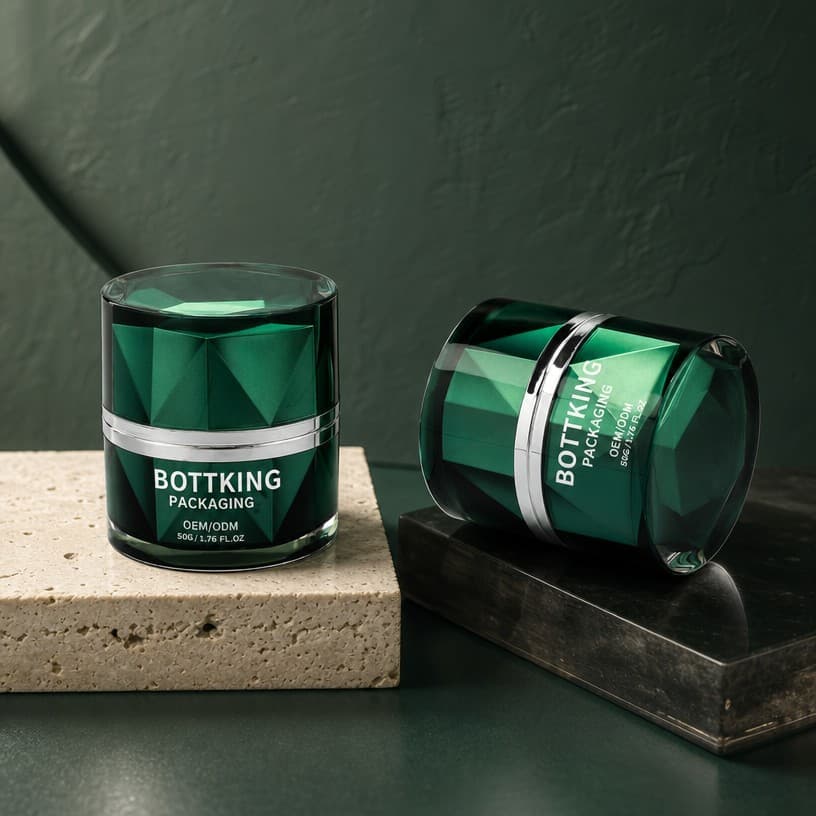
Acrylic (PMMA and SAN/AS) is the clearest and most glass-like cosmetic plastic, used for prestige jars, caps, thick-wall bottles and decorative outer components where weight and optical clarity drive value.
At a glance
- Best for
- Acrylic cosmetic jars · Double wall jars · Prestige cream jars
- Applications
- Prestige cream jars 15–100 ml with inner cups · Heavy-weight caps, collars and decorative rings · Thick-wall serum-look bottles with inner containers
- Key advantage
- Delivers prestige shelf presence and weight without glass breakage risk · Very large branding and finishing surface on jars and caps
- Decoration
- Spray coating in gloss, matte, satin and metallic finishes · Metallising for chrome-like accents
What is Acrylic used for in cosmetics?
Acrylic packaging exists to make plastic look and feel like glass. PMMA and SAN copolymers achieve optical clarity close to glass, with density around 1.18 g/cm³ — heavier than PP or PET, which is precisely the point for premium positioning.
Because acrylic is less resistant than PP to alcohol and essential oils, high-end constructions usually use acrylic as an outer shell and cap while a PP or PET inner cup holds the formula.
| Property | Value |
|---|---|
| Density | Around 1.18–1.20 g/cm³ |
| Clarity | Very high — glass-like transparency |
| Surface | High gloss; accepts coating, printing and metallising |
| Impact behaviour | Hard and scratch resistant, but relatively brittle |
| Chemical resistance | Poor to alcohol and essential oils in direct contact |
| Recycling code | 7 (other) — rarely collected |
| Common cosmetic uses | Prestige jars, caps, heavy bases, decorative components |
Material characteristics
- Highest optical clarity of the common cosmetic plastics
- Heavy, glass-like hand-feel that reads as premium
- Excellent finish capability: spray coating, metallising, printing, hot stamping
- Hard surface with good scratch resistance in normal use
- Can be produced in thick sections without visible flow lines
- Available in transparent, frosted and tinted versions
Applications
- Prestige cream jars 15–100 ml with inner cups
- Heavy-weight caps, collars and decorative rings
- Thick-wall serum-look bottles with inner containers
- Limited-edition and gift-set packaging
- Airless outer shells for premium lines
- Display and sampling components
Advantages
- Delivers prestige shelf presence and weight without glass breakage risk
- Very large branding and finishing surface on jars and caps
- Outer shell can be refilled or reused while the inner cup is replaced
- Excellent for travel retail and gift sets where appearance drives purchase
- Enables thick-wall, faceted and domed geometry that other plastics cannot hold as clearly
- Reduces breakage complaints in e-commerce compared with glass
Limitations to plan for
- Higher unit cost than PP or PET, and heavier to freight
- Brittle under impact — cracks rather than flexing, which needs robust cartons
- Not suitable in direct contact with high-alcohol or essential-oil-rich formulas
- Not accepted in most curbside recycling streams (code 7)
- Multi-part assemblies (shell, cup, liner, cap) complicate end-of-life separation
Formula compatibility
- Emulsified creams in an inner PP cup: good
- Direct contact with creams: possible but not preferred
- Alcohol-based formulas in direct contact: poor
- High-fragrance and essential-oil formulas in direct contact: poor
- Silicone and oil-based decorative use: generally acceptable
- Best practice: use acrylic as an outer component and a PP or PET inner for the formula
Sustainability and end of life
- Acrylic is code 7 and is not collected in most municipal recycling streams; it should not be described as recyclable
- The primary sustainability lever is reuse: refillable constructions keep the acrylic shell in service
- Separable inner cups allow the formula-contact part to be recycled in PP or PET streams while the shell is reused
- Refill-format acrylic jars reduce plastic per use compared with purchasing a new complete jar
- Weight increases freight emissions per unit, which should be accounted for in lifecycle comparisons
- Recycled acrylic is technically possible but rare in cosmetic packaging; claims must be verified per project
Decoration options
- Spray coating in gloss, matte, satin and metallic finishes
- Metallising for chrome-like accents
- UV and screen printing
- Hot stamping on caps and flat surfaces
- Domed labels and insert discs under clear lids
- Internal printing for depth effects behind clear walls
Suitable skincare products
- Acrylic cosmetic jars
- Double wall jars
- Prestige cream jars
- Airless outer shells
- Decorative caps and collars
Why a brand should choose Acrylic
- Choose acrylic when premium positioning and glass-like clarity outweigh unit cost
- Choose acrylic for gift sets, travel retail and limited editions where appearance is the product
- Choose acrylic when you want a refillable prestige pack with a reusable outer shell
- Choose PP or PET instead when cost, weight, recyclability or formula compatibility come first
Frequently asked questions
Is acrylic packaging suitable for skincare creams?
In jar constructions yes, because the formula is normally contained in a PP or PET inner cup rather than touching the acrylic. Direct contact with high-alcohol or essential-oil-rich formulas is not recommended.
Can acrylic jars be recycled?
Acrylic is resin code 7 and is not accepted in most municipal recycling systems, so it should not be marketed as recyclable. Its environmental advantage lies in reuse: refillable acrylic shells reduce material per use compared with buying new jars each time.
Why does acrylic feel heavier than PP?
Acrylic has a density of roughly 1.18 g/cm³ against about 0.90 g/cm³ for PP, and it is usually moulded with thicker walls and a weighted base. The weight is deliberate — it signals premium quality in the hand.
Does acrylic break easily?
It is harder and more scratch resistant than PP but less flexible, so impact can crack it. Tamper-resistant cartons and inserts are important, and we test carton drop performance for acrylic constructions before shipping.
Can acrylic outer shells be combined with airless engines?
Yes, and it is a common premium construction: the acrylic shell and cap carry the appearance, while a PP inner container and airless engine handle the formula and the dosing.
Still have a question? Talk to a packaging expert.
Continue researching
Acrylic packaging quotes and samples
Tell us the format, capacity, quantity and any recycled-content target and we will confirm which Acrylic grade fits your formula, plus MOQ, sampling and lead time.
No account required · NDA available · Quote replies within one business day (Mon–Sat, GMT+8)