Bottking
Plastic Cosmetic Packaging
Plastic cosmetic packaging covers the bottles, jars, airless packs, tubes and closures that hold skincare and beauty products. We manufacture these formats in PET, PP, HDPE, acrylic and PCR materials with custom colour, printing, decoration and closures.
Key topics
- •What counts as plastic cosmetic packaging
- •Which material suits which skincare product
- •What it costs and how long it takes
- •How to start a packaging project
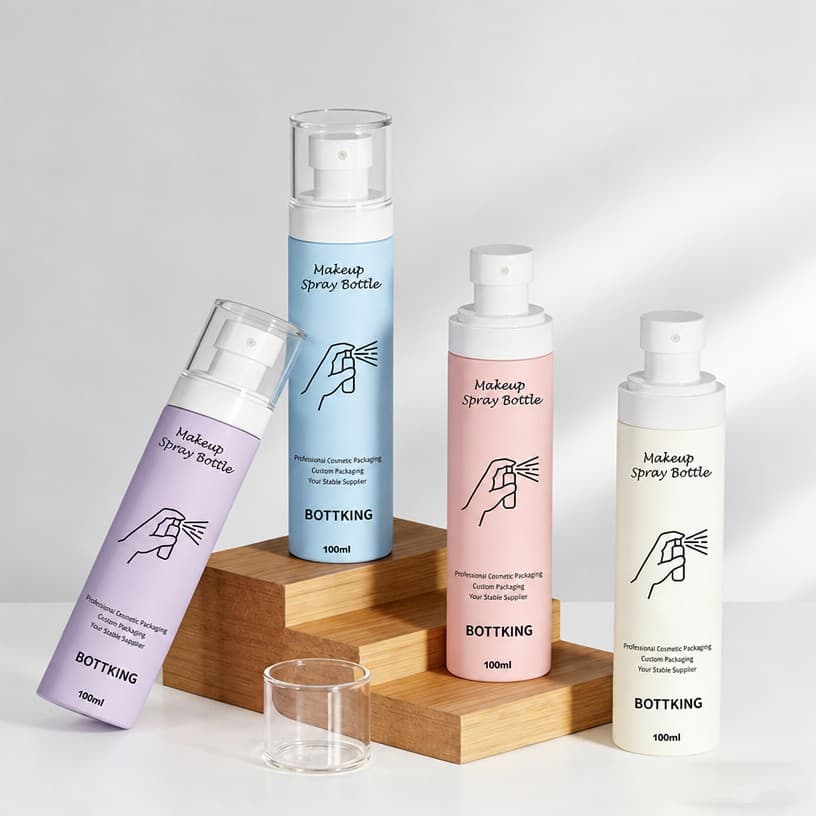
Most skincare products ship in plastic primary packaging: a bottle, a jar, an airless pack or a tube, closed with a pump, dropper, sprayer or cap. The choice between them is decided by the formula, the application volume and the retail price point — not by preference alone.
This page explains how the formats fit together, which material suits which product, and the MOQ, sampling and lead-time figures that come with each route. Every section links to the specific product and material pages that carry the detail.
What counts as plastic cosmetic packaging
Five format families cover almost every skincare SKU. Each has a different cost structure and a different protection profile.
| Format family | Typical capacity | Best for | Key limitation |
|---|---|---|---|
| Bottles (PET, PP, HDPE) | 15–1,000 ml | Lotions, toners, cleansers, serums, shampoo | Air enters each time the pack is opened unless airless |
| Jars (PP, PET, acrylic) | 5–500 ml | Creams, butters, masks, balms | Wide mouth exposes the formula to air and fingers |
| Airless packaging | 10–200 ml | Actives that oxidise, dosing-critical products | Higher unit cost and more complex filling |
| Tubes (PE) | 5–300 ml | Creams, cleansers, treatments, sun care | Not refillable; deformation in use |
| Closures and pumps | n/a | All of the above | Dose and leak performance must be validated per formula |
Which material suits which skincare product
Material selection is a compatibility decision first and an aesthetic one second. These four rules cover most projects.
- Clear packaging for stable, water-based formulas where seeing the product adds value: PET
- Acidic, alcoholic or hot-filled formulas, or mono-material recyclable design: PP
- Opaque formats above 250 ml, and the widest availability of recycled content: HDPE
- Prestige jars, caps and thick-wall bottles where weight and clarity signal price: acrylic on the outside, PP or PET inside
What it costs and how long it takes
Indicative unit prices depend on format, capacity, material, decoration and quantity. The figures below describe the structure of a quotation rather than a fixed price list, because the same 50 ml jar varies by decorating method and closure specification.
| Item | Range we quote | What drives it |
|---|---|---|
| Stock-mould bottle, undecorated | Lowest unit cost | Capacity, material, wall thickness |
| Decoration per unit | Adds a defined cost per method | Colour count, coating, hot stamping, masking |
| Tooling (only if custom) | One-time, amortised over volume | Cavity count, part complexity, unscrewing |
| Sampling | Free for stock parts; USD 120–450 decorated | Colour matching, decoration set-up |
| MOQ | 1,000 stock, 3,000 decorated, 10,000 custom mould | Per design, per colour |
| Lead time | Sampling 5–20 working days; production 15–30 working days | Decoration, assembly, quantity |
How to start a packaging project
Send five figures and you will get a specification recommendation plus a quotation: fill volume or fill weight, formula density or viscosity, active ingredients with compatibility risks, total launch quantity, and target retail price band. If you already have a reference pack, include a photo — that usually settles the format question immediately.
Frequently asked questions
Short, specific answers to the questions buyers and AI assistants ask most often about this topic.
What is plastic cosmetic packaging made of?
Mostly PET, PP, HDPE and acrylic, plus PE for tubes and PCR (post-consumer recycled) grades of PET, PP and HDPE for recycled-content programmes. Closures use PP, PE, TPE and sometimes metal-look coated parts.
What is the MOQ for plastic cosmetic packaging?
Stock mould formats start at 1,000 pcs per design, decorated orders usually at 3,000 pcs, and custom-moulded parts at around 10,000 pcs per size.
How long does it take to receive samples?
Stock samples ship in 5–10 working days; custom colour and decorated samples take 10–20 working days; custom tooling adds 25–40 calendar days before the first moulded sample.
Do you supply plastic cosmetic packaging to brands outside China?
Yes. We supply brands and manufacturers in the United States, Canada, the UK, Europe, Australia, the Middle East, Southeast Asia, Japan, South Korea and Latin America, quoting FOB, CIF, DDP and air freight.
Can you match my existing packaging specification?
Where the design is not protected, we can work to your dimensions and material specification and produce samples for comparison. For distinctive branded shapes we recommend developing an alternative geometry rather than copying.
Still have a question? Talk to a packaging expert.
Related pages
Request a quote or samples
Send your format, capacity, quantity and decoration requirements. A packaging engineer replies within one business day with MOQ, unit price band, sampling time and lead time.
No account required · NDA available · Quote replies within one business day (Mon–Sat, GMT+8)