Material guide
PE Cosmetic Packaging
Polyethylene (LDPE, LLDPE and blends)
PE is the flexible side of the polyethylene family: LDPE and LLDPE are used for squeeze tubes, soft closures, dropper bulbs and liners, where flexibility and sealing matter more than rigidity.
At a glance
- Best for
- Plastic tubes · Squeeze tubes · Caps & closures
- Applications
- Squeeze tubes for cleanser, cream, treatment and sun care · Trial and deluxe tube formats (5–30 ml) · Flip-top, disc and push-pull closures with LDPE sealing parts
- Key advantage
- The most economical route to a squeezable pack with near-complete evacuation · Allows tube heads to be sealed and shoulders to be formed in one process
- Decoration
- Offset printing for high-definition multi-colour artwork · Flexo printing for cost-efficient two to four colour designs
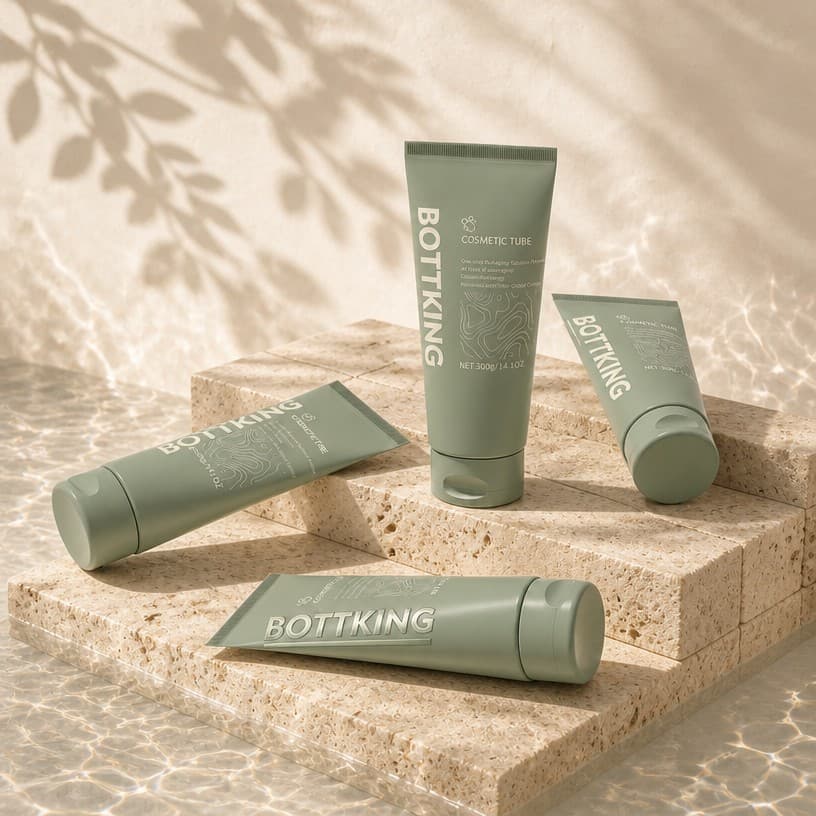
What is PE used for in cosmetics?
The abbreviation PE covers a family rather than one material. HDPE is the rigid grade used for bottles; LDPE and LLDPE are the flexible grades used for tube walls, caps, liners, plugs and soft-touch components.
Knowing the difference matters commercially: a tube quote depends on the layer structure and on which grade carries the print, and a closure quote depends on whether the sealing part is LDPE, TPE or a gasket insert.
| Property | Value |
|---|---|
| Density | 0.91–0.94 g/cm³ (LDPE/LLDPE) |
| Clarity | Transparent to translucent in thin walls |
| Flexibility | High — the defining property of these grades |
| Heat sealability | Excellent — the basis of tube head sealing |
| Chemical resistance | Good for water-based and acidic formulas |
| Recycling codes | 4 (LDPE) and 2 (HDPE) |
| Common cosmetic uses | Tubes, caps, liners, plugs, bulbs, soft components |
Material characteristics
- Flexible and squeezable without cracking
- Excellent heat-sealing, which makes tube production possible
- Soft to the touch in low-density grades
- Transparent to translucent in thin sections
- Good low-temperature performance
- Compatible with barrier layers such as EVOH in coextruded tubes
Applications
- Squeeze tubes for cleanser, cream, treatment and sun care
- Trial and deluxe tube formats (5–30 ml)
- Flip-top, disc and push-pull closures with LDPE sealing parts
- Gaskets, plugs and liners in lids and caps
- Dropper bulbs and soft applicator parts
- Bottle-overcaps and protective covers
Advantages
- The most economical route to a squeezable pack with near-complete evacuation
- Allows tube heads to be sealed and shoulders to be formed in one process
- Soft grades give closures and inserts a good sealing interface
- Low density keeps raw material weight down
- Compatible with post-consumer recycled PE in tube bodies and caps
- Works with high-quality offset, flexo and digital printing on the outer layer
Limitations to plan for
- Not rigid — unsuitable as a standalone bottle material
- Lower barrier to oxygen and fragrance than EVOH-containing constructions
- Flexible grades absorb some fragrance and oil components over time
- Thin flexible walls offer less protection against panel damage in transit
- Typically requires multi-layer construction to combine print, barrier and contact safety
Formula compatibility
- Water-based creams, gels and cleansers: excellent
- Acidic formulas: good
- Alcohol-based formulas: good in multi-layer tubes
- Oils and emulsions: good, with fragrance-load testing for flexible parts
- High-fragrance formulas: caution — flexible PE absorbs some components
- Formulas requiring barrier protection: use EVOH-containing tube constructions
Sustainability and end of life
- PE tubes are increasingly available with PCR-PE bodies and PCR caps
- Mono-material PE tube, shoulder and cap constructions are the easiest to present as recyclable
- Removing or reducing the label and using direct print improves sorting efficiency
- Coextruded structures with EVOH improve protection but add a non-PE layer, which affects recyclability assessments
- PE resists cracking, so flexible packs tend to be durable in transport, reducing damage-related waste
- Recycled content percentages must be verified against the resin grade; we quote the certified figure only
Decoration options
- Offset printing for high-definition multi-colour artwork
- Flexo printing for cost-efficient two to four colour designs
- Screen printing for metallic and thick inks
- Digital printing for short runs and multi-variant launches
- Gloss, matte and soft-touch over-lamination
- Hot stamping for logos and metallic accents
Suitable skincare products
- Plastic tubes
- Squeeze tubes
- Caps & closures
- Travel size tubes
- Cosmetic tube packaging
Why a brand should choose PE
- Choose PE when the product is a cream, gel or paste that dispenses best by squeezing
- Choose PE when you want full-surface print with lower unit cost than rigid formats
- Choose PE for closures, inserts and liners that need a flexible sealing interface
- Choose HDPE instead when the pack must be rigid, and PP when a living hinge or higher heat resistance is needed
Frequently asked questions
What is the difference between PE and HDPE?
Both are polyethylenes. HDPE is the rigid, dense grade used for bottles and jars. LDPE and LLDPE are flexible grades used for tubes, caps, liners and soft parts. A 'PE tube' is made from flexible grades; an 'HDPE bottle' is rigid.
Can PE tubes be recycled?
PE tubes are monomaterial to a large degree, and mono-material PE constructions with PE caps are increasingly accepted in plastics collection where tubes are captured. Barrier tubes containing EVOH or other polymers complicate recycling, so claims must reflect the actual structure.
How many layers does a cosmetic PE tube have?
Typically five to seven: an outer print layer, adhesive or tie layers, a barrier layer where needed, and an inner contact layer. Each layer has a function, and the structure is specified per formula requirement.
Is PE suitable for high-fragrance products?
Flexible PE can absorb fragrance components, which may shift the scent profile over time or cause weight loss in the pack. For high fragrance or essential oil loads we run a soak test on the finished tube, or move to a barrier construction.
Which PE grade is used for flip-top caps?
Usually PP for the body of a hinge cap, with an LDPE or TPE sealing plug to ensure the closure seals against the bottle neck. That combination balances hinge life with sealing performance.
Still have a question? Talk to a packaging expert.
Continue researching
PE packaging quotes and samples
Tell us the format, capacity, quantity and any recycled-content target and we will confirm which PE grade fits your formula, plus MOQ, sampling and lead time.
No account required · NDA available · Quote replies within one business day (Mon–Sat, GMT+8)